
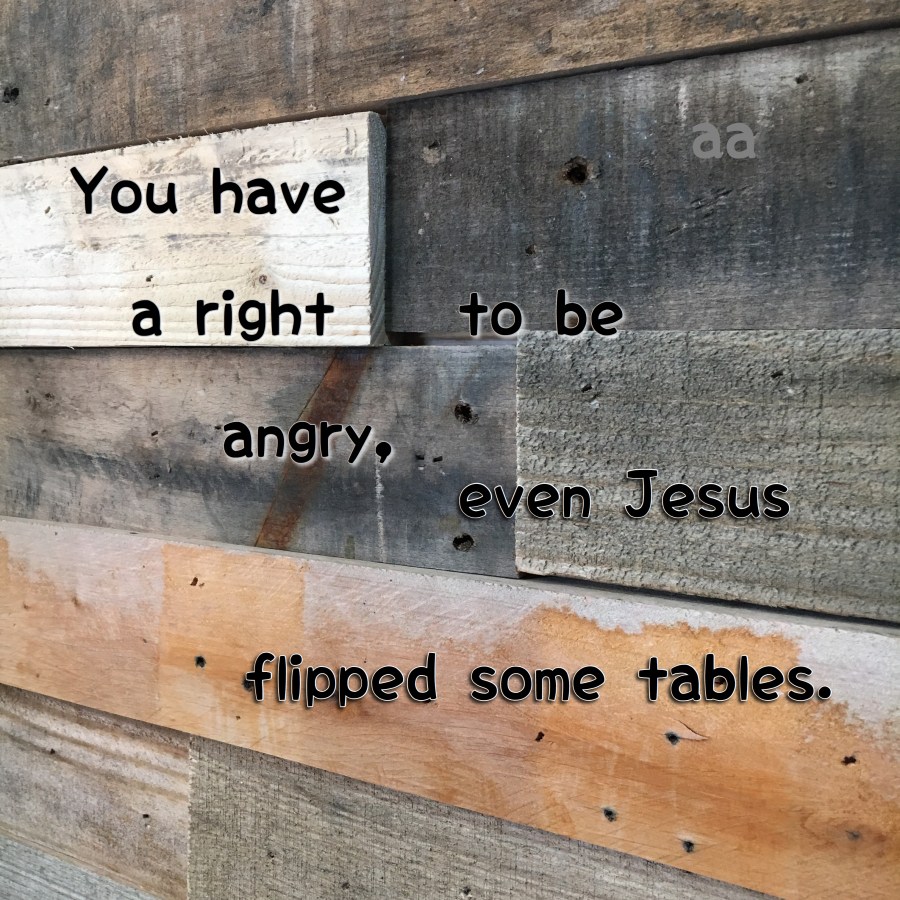
You are allowed to be angry, even Jesus flipped some tables. I couldn’t begin to track the times I went from zero to one hundred in a rage because of the injustice I suffered. That type of fury was always justified, just not to the ones witnessing it. I had come by it honestly though since my father expressed his inner resentments outwardly through hands balled up like fists, while my mother dug her nails into my skin while silently seething. The common denominator was the look each one gave that shot fear through my body and caused me to freeze. Dad would give me something to cry about if my emotion triggered his feeling out of control, and mom would slap the silly right of me because she needed to control my laughter. I couldn’t win. Every time I turned around the rules changed and the tyranny under my parents domain was immeasurable. By the time I was seven years old my anger had turned inward and cloaked me with depression that would follow me through my adult life. It wasn’t until my moments of outburst signaled that a broken heart needed to express itself, that I befriended the angry parts within and thanked them for allowing me to overturn some tabletops of my own.
We have four groups of compartmentalized emotions that are labeled either sad, happy, fearful or angry. I think that is a fine baseline to work from, but once each category is uncovered we can find a wide range of emotions that depict different parts within them. Parts of us hold emotion on a spectrum, which is why verbiage is powerful when describing our pain to another. In childhood I made sense of the small trauma I experienced of daily getting talked down too, and freezing from a look, to be a part that felt controlled. Because I was little and didn’t have the vocabulary to explain the inner conflict, I believed making my parents angry was my fault. I was not at liberty to show emotion because of the unrest it would stir in them. Hence, the guilt part was birthed. Then another part of me felt powerless and it worked in tandem with a part that manifested my depression. Because I also lived through sexual and physical abuse which is defined as big trauma, my system had to place protective measures around my inner child that labeled all of my escalating angry parts. Throughout my IFS Therapy work I have discovered a vast continuum of emotions that emerged as agitated, aggressive, hostile, disdainful, hateful, violent, murderous, disgust, disapproving, control, rage, fury and vengeful parts.
Fleshing out my relationship to each degree of my angry parts would be impossible on paper because unlocking their jobs required many hours of hearing their stories. Each role a part played in my system to protect the fragile inner child whom lived through perceived trauma, needed to express all of its intertwining emotions. That’s why the church misses the point when it labels behavior as sinful and wants to make it stop or get rid of it. Jesus had many parts of Him who addressed the injustice going on under His Fathers roof. His depth of understanding why humans behave selfishly and exploitatively were wrapped up in the explosive, angry, disapproving parts that launched tables across the church floor. That same emotional understanding could have been polarized with sad, grieving, and regretful parts that brought tears to His eyes. After all, getting to the bottom of emotional suffering for the sake of redeeming it, is why He had to come in human form. The progression of pain in a persons psyche is why God utilizes parts to protect the inner child from destruction before adulthood. Jesus exemplified best that all parts are welcome, even those that seem destructive.

 REVELATIONS FROM DADDY IN HEAVEN